

Introduction
Poetry is compact, rhythmic writing that turns feeling into images. thoughtsinenglish.org shares 10 definitions, examples, Urdu, love and sad poetry, plus caption-ready lines.
By Ahmad, founder and editor of thoughtsinenglish.org
Poetry is a form of writing that uses rhythm, imagery, and carefully chosen words to express feeling, memory, or an idea in fewer words than prose needs. On thoughtsinenglish.org, poetry sits close to quotes and captions, so this guide is written for students, readers, and writers who want a clear definition, real examples, and short lines they can use in a text post, a story, a card, or an Instagram caption. You will also find sections on poetry in Urdu, love poetry, sad poetry, and poetry videos.
Table of Contents
- How We Choose These Poetry Lines
- 10 Definitions of Poetry
- Poetry Examples: Haiku, Couplet, and Acrostic
- Poetry in English: The Basics
- Poetry in Urdu
- Love Poetry
- Sad Poetry
- Poetry Video: How to Turn a Poem into a Reel
- Poetry in Text: Caption Formula
- Mistakes to Avoid
- Key Takeaways
- FAQs
- Tags
How We Choose These Poetry Lines
The poetry collection at thoughtsinenglish.org follows three rules for readers who want to post, share, or study short lines. Every line must be short enough to read in one breath, clear enough to understand without a footnote, and either properly attributed or written by us.
For definitions, we checked each line against the author’s own essay or a recognised reference and removed any wording we could not trace. Where a line is commonly repeated online without a source, we label it “Attributed to.” The verses in the examples sections are labelled Original by thoughtsinenglish.org, and none of them is credited to a real poet. We do not reproduce full poems, since most poetry is protected by copyright.
10 Definitions of Poetry

For students and writers, thoughtsinenglish.org collects ten definitions of poetry from a dictionary, an ancient philosopher, famous poets, and our own editorial desk. No single definition is complete, and that is part of why poets keep writing new ones.
- Dictionary meaning. The Britannica Dictionary defines a poet as a person who writes poems, so poetry is the writing of poets. It also uses the word for anything graceful, as in “poetry in motion.”
- Aristotle, Greek philosopher. He described poetry as imitation (mimesis) of life and action.
- William Wordsworth, English Romantic poet. In the preface to Lyrical Ballads (1800), he called poetry “the spontaneous overflow of powerful feelings.”
- Samuel Taylor Coleridge, English poet and critic. In Table Talk (1835), he is recorded saying poetry is “the best words in the best order.”
- Percy Bysshe Shelley, English Romantic poet. In A Defence of Poetry, he wrote that poetry is “the record of the best and happiest moments of the happiest and best minds.”
- Robert Frost, American poet. In his essay “The Figure a Poem Makes,” he described the moment when “an emotion has found its thought and the thought has found words.”
- Carl Sandburg, American poet. Attributed to him: poetry is “an echo, asking a shadow to dance.”
- Emily Dickinson, American poet. According to her reader Thomas Wentworth Higginson, she said she knew a poem was real when it made her feel physically unsettled, as if the top of her head had been lifted.
- Audre Lorde, American poet and essayist. Her 1977 essay “Poetry Is Not a Luxury” argues that poetry is a necessity for naming feelings and ideas, not a decoration.
- Original by thoughtsinenglish.org. Poetry is a feeling given a shape small enough to carry.
Definitions work best as short captions on quote cards. For a worked example, take the Wordsworth line:
Quote: “the spontaneous overflow of powerful feelings”
Author: William Wordsworth, English Romantic poet
Best use: Caption for a journal page or a late-night writing photo
Sample caption: Some poems are just feelings that ran out of room. #poetry #writersofinstagram #poetrycommunity
| Quote | Author | Word count | Best for |
|---|---|---|---|
| “the spontaneous overflow of powerful feelings” | William Wordsworth | 6 | Journal captions, emotional posts |
| “the best words in the best order” | Samuel Taylor Coleridge | 7 | Writing tips, student notes |
| “the record of the best and happiest moments of the happiest and best minds” | Percy Bysshe Shelley | 14 | Quote cards, speeches |
| “an emotion has found its thought and the thought has found words” | Robert Frost | 12 | Essays, reflective captions |
| “an echo, asking a shadow to dance” (attributed) | Carl Sandburg | 7 | Short Instagram captions |
| Some nights the silence is louder than anything I never said. | Original by thoughtsinenglish.org | 11 | Sad poetry posts |
| You are the quiet in my loudest day. | Original by thoughtsinenglish.org | 8 | Love poetry captions |
Poetry Examples: Haiku, Couplet, and Acrostic
Poetry examples help new readers at thoughtsinenglish.org see how form changes meaning, so here are three short forms, each written by us. The Academy of American Poets lists many more forms if you want to explore further.
Haiku is a short form that comes from Japan and is traditionally built in three lines of 5, 7, and 5 syllables. For more Japanese-inspired lines, see our Japanese quotes.
Rain on the window,
the page I could not finish
writes itself in drops.
Original by thoughtsinenglish.org
Couplet is a pair of lines, rhymed or not.
I wrote my doubts on a paper boat,
and watched them learn how to float.
Original by thoughtsinenglish.org
Acrostic uses the first letter of each line to spell a word.
Paper holds what the mouth cannot say.
Open the window and let the feeling in.
Every line is a small, brave step.
Morning begins when the last word lands.
Original by thoughtsinenglish.org
Quote: the haiku above
Author: Original by thoughtsinenglish.org
Best use: Rainy-day photo or a desk-setup story
Sample caption: Rain wrote this one. #haiku #poetryexamples #rainydays
Poetry in English: The Basics
Poetry in English, for readers and students on thoughtsinenglish.org, usually relies on a few tools that are easy to spot once you know them. Imagery paints a picture, metaphor says one thing through another, and rhythm gives lines their pulse. Rhyme is optional, since blank verse follows a regular meter without rhyming.
The Academy of American Poets glossary explains terms such as alliteration, enjambment, couplet, and stanza in plain language. If a poem feels confusing, read it aloud once, then look at its images before worrying about its meaning.
Poetry in Urdu

Poetry in Urdu, a major tradition for Urdu and Roman Urdu readers on thoughtsinenglish.org, is built mainly on the ghazal and the nazm. A ghazal is a series of self-contained couplets, and each couplet is called a sher. A nazm is a poem that follows one theme from start to finish.
Mirza Asadullah Khan Ghalib, a 19th-century Urdu poet, is widely regarded as one of the greatest Urdu poets, and his ghazals remain loved across South Asia. Many readers today share Urdu poetry in Roman script because it is easy to type in a caption or message.
Lafzon ne jab khamoshi ko awaaz di,
dil ka har dukh ek sher ban gaya.
Original by thoughtsinenglish.org
Quote: the sher above
Author: Original by thoughtsinenglish.org
Best use: WhatsApp status or a late-night story
Sample caption: Har dukh ka ek sher hota hai. #urdupoetry #romanurdu #sher
Love Poetry
Love poetry on thoughtsinenglish.org is written for couples, friends, and anyone drafting a card or a message. The strongest love lines are specific and small, such as a quiet room or a morning habit, not a list of big claims. If your love poem leans toward hope and wishes, our quotes about dreams pair well with it.
You are the quiet in my loudest day,
the home I did not know I was walking toward.
Original by thoughtsinenglish.org
Quote: “You are the quiet in my loudest day”
Author: Original by thoughtsinenglish.org
Best use: Anniversary card or a message to a partner
Sample caption: Home is a person. #lovepoetry #poetryforher #lovelines
Sad Poetry
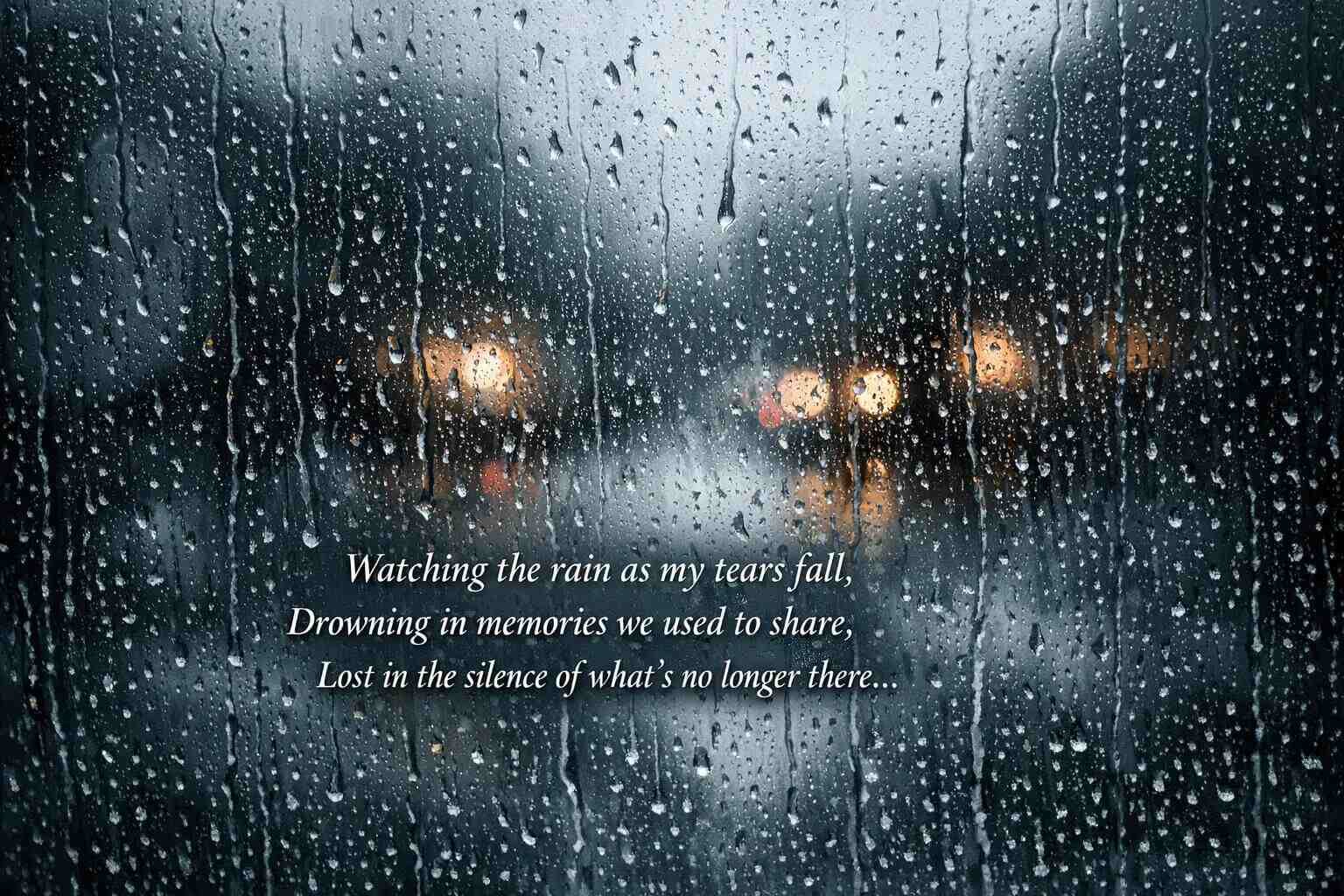
Sad poetry, for readers on thoughtsinenglish.org who want words for loss, distance, or a hard week, works best when it stays honest and short. A sad poem does not need to fix anything. It only needs to say the feeling clearly enough that someone else can recognise it. If you want something gentler after a heavy line, our rainbow quotes offer a lighter turn.
Some nights the silence is louder
than anything I never said.
Original by thoughtsinenglish.org
Quote: “Some nights the silence is louder than anything I never said.”
Author: Original by thoughtsinenglish.org
Best use: Dark-background quote card or a late-night story
Sample caption: Not every night needs a reason. #sadpoetry #poetryquotes #quietnights
Poetry Video: How to Turn a Poem into a Reel

A poetry video, for creators publishing on thoughtsinenglish.org-style pages, is simply a short poem set to text, voice, or soft background sound. Keep it to one poem of two to four lines. Show each line for long enough to read comfortably, use a plain readable font on a calm background, and read aloud if you want a voiceover.
Use only music you have the right to use, and credit the poet if the poem is not yours. Our humble quotes are a good source of plain, modest lines that suit a quiet video.
Poetry in Text: Caption Formula

Poetry in text, meaning poems shared as captions, status updates, or messages, follows a simple formula on thoughtsinenglish.org. Use one line of poetry, one line of personal context, and 3 to 5 hashtags.
Formula: Poem line + one-line context + 3-5 hashtags
Keep the poem line under 15 words for a caption. For longer poems, post the first two lines and invite readers to continue in the comments.
Mistakes to Avoid
Poetry writers and sharers on thoughtsinenglish.org run into the same few problems.
- Misattribution. Never attach a famous name to a line just because other sites do. If you cannot trace it, say “Unknown” or “Attributed to.”
- Posting long copyrighted poems. Share a short line and credit the poet instead.
- Over-long captions. Keep the line short and the context shorter.
- Forcing rhyme. A clear unrhymed line beats a rhyme that bends the meaning.
Key Takeaways
- Poetry is compact, rhythmic writing that turns feeling into images.
- No single definition is complete, and ten of them are listed above.
- Poetry does not have to rhyme.
- Urdu poetry is built on the ghazal, the sher, and the nazm.
- For captions, keep the poem line short and always credit the author.
FAQs
Does poetry have to rhyme?
No, poetry does not have to rhyme. Blank verse follows a regular meter without rhyme, and free verse follows no fixed pattern at all.
What is the difference between a poem and a quote?
A poem is a complete piece of writing shaped by rhythm and line breaks, while a quote is a single line taken from a speech, book, or conversation. Many captions blend the two, which is why we label original lines clearly.
Which poetry should I use for which situation?
Use short love lines for cards and messages, sad poetry for late-night stories, and definitions for study notes or quote cards. Haiku suits photos with a single clear image.
How long should a poetry caption be?
Keep the poem line under 15 words and add 3 to 5 hashtags. Longer poems work better as images or videos than as captions.
What is a sher in Urdu poetry?
A sher is a single couplet in Urdu poetry, and a ghazal is made of several of them. Each sher is meant to stand on its own.
Can I post lines from famous poems as captions?
Short, properly credited lines are common practice, but long passages are a copyright risk. When unsure, write your own line or link to the poem’s source.
Ready to put a line on your phone? Browse our wallpaper quotes and pick one that fits your screen.
[…] Many older guides say Hello Poetry is invite-only. The site’s own FAQ, checked on October 9, 2026, describes a plain email sign-up instead, so some advice online is out of date. For more on poetry in general, see thoughtsinenglish.org’s poetry basics guide. […]