
Introduction
By Ahmad, founder and editor of thoughtsinenglish.org
Published: October 9, 2026 | Last updated: October 9, 2026
Famous poetry is the group of poems and poets that readers keep returning to across generations, from Urdu ghazals by Mir Taqi Mir and Mirza Ghalib to English poems by Robert Frost and Emily Dickinson. This guide from thoughtsinenglish.org, our site for quotes, captions and poetry, introduces the poets, the best-known poems and the ways students, caption writers and poetry readers can use them.
We name poems and describe what they are about, but we do not paste full texts. For readers who want a caption, we add original lines written for this page and labelled as such.
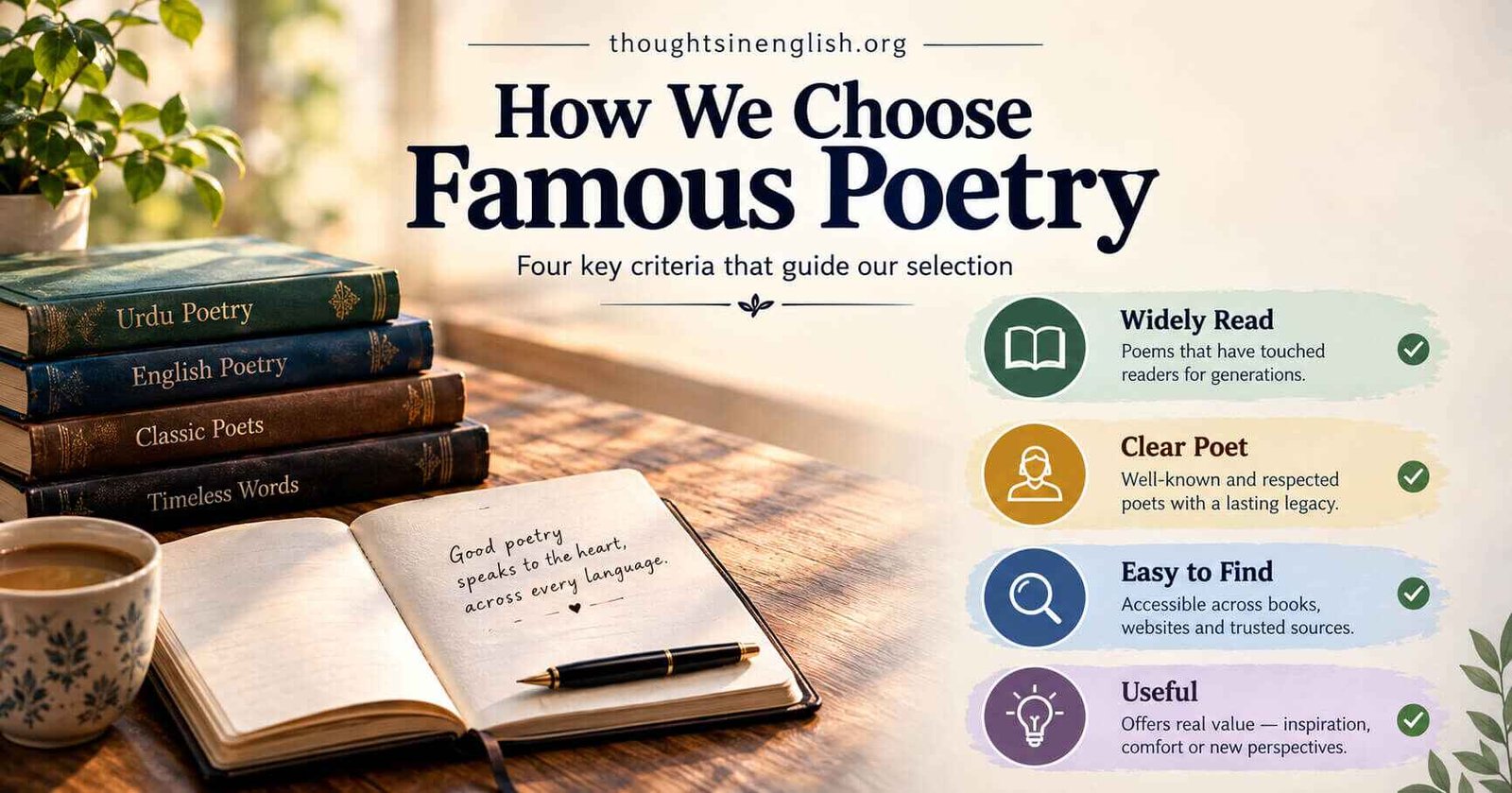
How We Choose Famous Poetry for This Page
On thoughtsinenglish.org, a poem or poet makes this list when it meets four criteria: it is widely taught or widely read, the poet is clearly identifiable, the poem is easy to find by its title, and it suits real uses such as reading aloud, studying or writing a caption.
We keep attribution careful. Poets are introduced with full name and descriptor, and facts such as dates and collections are stated only where they are well documented. Verses that circulate online without a clear source are left out. Lines marked “Original by thoughtsinenglish.org” are written for this page and are not by any famous poet.
Famous Poetry in Urdu: The Forms and the Voices
Famous poetry in Urdu is built mainly on two forms: the ghazal, a set of independent couplets that share a rhyme and a mood, and the nazm, a poem that develops one theme from start to finish. Love, loss, longing, faith, freedom and social change appear again and again in both forms.
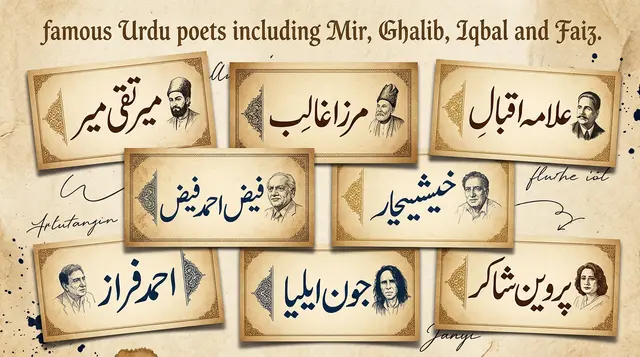
The poets below are among the most studied and quoted in Urdu. Each one is a different entry point, depending on what you want to read.
| Poet | Descriptor | Known for |
|---|---|---|
| Mir Taqi Mir (1723-1810) | Urdu poet, born in Agra | Ghazals of sorrow in simple language |
| Mirza Ghalib (1797-1869) | Urdu and Persian poet, born in Agra, lived in Delhi | Layered ghazals and famous letters |
| Allama Muhammad Iqbal (1877-1938) | Poet and philosopher, born in Sialkot | Poems of selfhood, awakening and faith |
| Faiz Ahmed Faiz (1911-1984) | Urdu poet, born near Sialkot | Romantic and political poetry |
| Parveen Shakir (1952-1994) | Urdu poet, born in Karachi | Modern voice on love and womanhood |
| Ahmad Faraz (1931-2008) | Urdu poet, born in Kohat | Romantic ghazals and protest poetry |
| Jaun Elia (1931-2002) | Urdu poet, born in Amroha, later of Karachi | Intense, personal, conversational style |
Mir Taqi Mir Famous Poetry
Mir Taqi Mir, the 18th-century Urdu poet from Agra, is often called “Khuda-e-Sukhan” (the god of poetry) and is known for ghazals of grief delivered in plain, everyday words. His collected work is organised in six diwans.
Readers who find Ghalib too dense often start with Mir, because his lines feel spoken rather than constructed. His famous poetry works well for quiet reading and for sad, reflective captions. It is best read in a good anthology with explanations, since his language is older Urdu.
Mirza Ghalib in Brief
Mirza Ghalib, the 19th-century poet who lived in Delhi, is the other giant of the classical ghazal. His Urdu diwan is short but heavily studied, and his letters are valued as early modern Urdu prose. Because many unrelated verses are shared online under his name, check any couplet against a printed diwan before you caption it.
Most Famous Poet of Pakistan
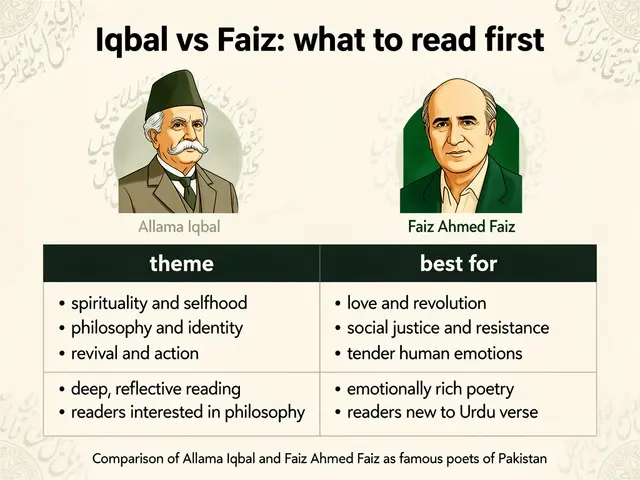
Allama Muhammad Iqbal is widely regarded as the national poet of Pakistan, which is why he is the usual answer to this question. He is honoured as the poet-philosopher of the country, and his birthday is observed in Pakistan.
“Most famous” is not an official ranking, though. Faiz Ahmed Faiz is equally loved, especially for his romantic and political poems, and he won the Lenin Peace Prize in 1962. Readers who want ideas and inspiration usually go to Iqbal, and readers who want love and resistance usually go to Faiz.
Allama Iqbal: 10 Famous Poems in Urdu
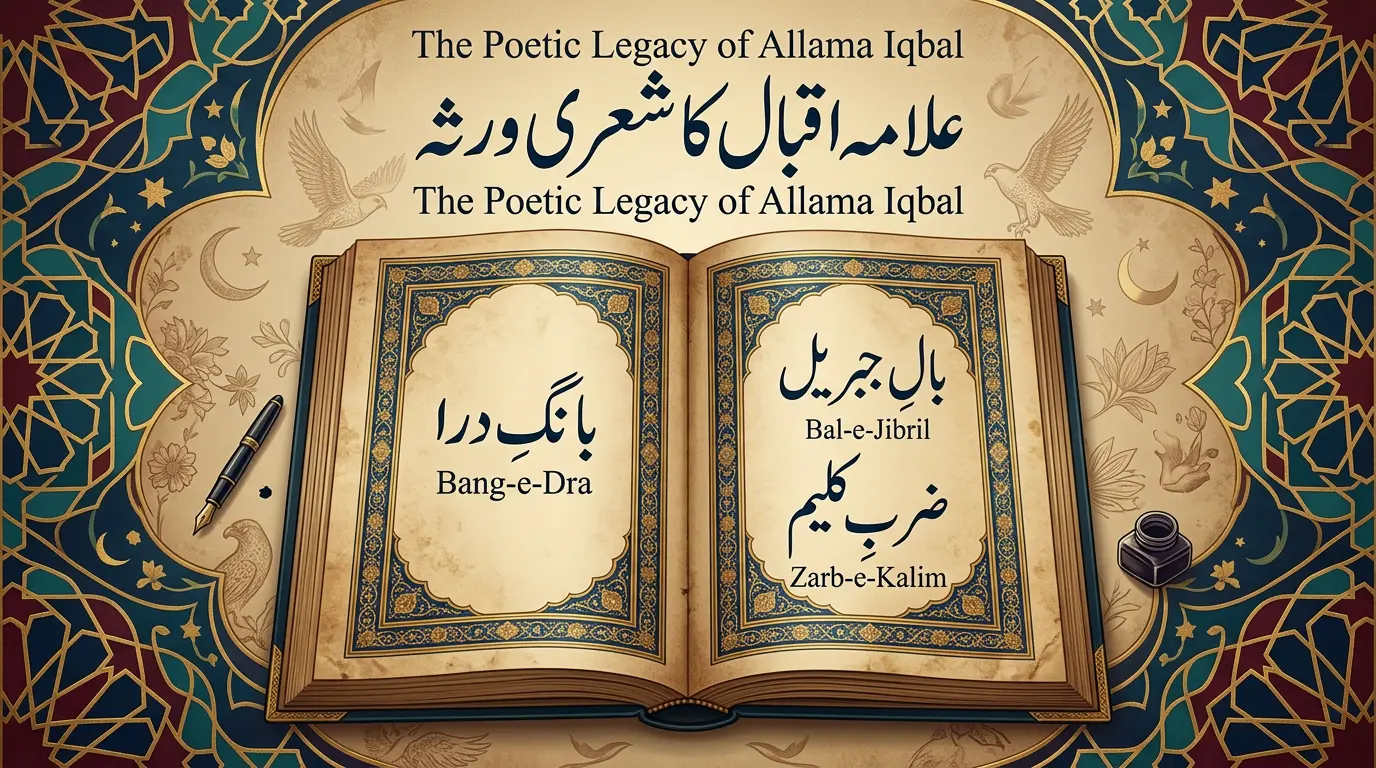
Allama Iqbal’s best-known Urdu poems appear mostly in three collections: Bang-e-Dra (1924), Bal-e-Jibril (1935) and Zarb-e-Kalim (1936). The ten below are commonly anthologised and taught. This is an editorial selection, not an official top-10 ranking.
| # | Poem | Collection | Main theme |
|---|---|---|---|
| 1 | Himalaya | Bang-e-Dra | Nature and national pride |
| 2 | Parinde Ki Faryad | Bang-e-Dra | Freedom and captivity (a child-friendly poem) |
| 3 | Tarana-e-Hindi (Sare Jahan Se Accha) | Bang-e-Dra | Love of homeland, written in 1904 |
| 4 | Lab Pe Aati Hai Dua | Bang-e-Dra | A prayer for children, often recited in schools |
| 5 | Shikwa | Bang-e-Dra | A complaint addressed to God |
| 6 | Jawab-e-Shikwa | Bang-e-Dra | The reply to Shikwa |
| 7 | Tarana-e-Milli | Bang-e-Dra | Community and unity |
| 8 | Masjid-e-Qurtuba | Bal-e-Jibril | Time, art and faith, inspired by Spain |
| 9 | Zauq-o-Shauq | Bal-e-Jibril | Love and spiritual longing |
| 10 | Saqi Nama | Bal-e-Jibril | Awakening and purpose |
Students usually begin with numbers 2, 3 and 4 because they are short and clear. Shikwa and Jawab-e-Shikwa are best read together, since the second answers the first.
Best Urdu Poets of the 21st Century
There is no official list of the best Urdu poets of the 21st century. The poets below are widely read, recited at mushairas or popular online since 2000. This is an editorial selection, not a ranking.
- Iftikhar Arif, Pakistani poet known for his modern ghazal and religious poetry.
- Kishwar Naheed, Urdu poet and feminist voice from Pakistan.
- Zehra Nigah, Urdu poet known for her nazms and her recitation style.
- Amjad Islam Amjad, Pakistani poet and playwright, widely read for his ghazals and TV writing.
- Rahat Indori, Indian Urdu poet known for his strong mushaira performances.
- Munawwar Rana, Indian Urdu poet known for his poems on family and mothers.
- Tehzeeb Hafi, young Pakistani poet who became very popular online.
Parveen Shakir, Ahmad Faraz and Jaun Elia (in the table above) did their main work earlier but are still read heavily by today’s young audience, which is why they feel “contemporary”.
Famous Poetry in English
Famous poetry in English covers more than 400 years of poems, from Shakespeare’s sonnets to modern American voices, and many of the best-known examples are short enough to read in two minutes. If you read Urdu poetry in translation, the same themes (love, nature, death, hope, struggle) will feel familiar.
Short Famous Poems (16 Lines or Fewer)
Short famous poems are the most useful for captions, status updates, school recitations and quick reading. The poems below are short, widely taught and easy to find by title.
| Poem | Poet (descriptor) | Length | Best for |
|---|---|---|---|
| The Red Wheelbarrow | William Carlos Williams, American poet | 16 words | Minimalism, photo captions |
| Dreams | Langston Hughes, American poet | 8 lines | Motivation, goals |
| Hope Is the Thing with Feathers | Emily Dickinson, American poet | 12 lines | Hope, hard days |
| Sonnet 18 | William Shakespeare, English playwright and poet | 14 lines | Love, tributes |
| Ozymandias | Percy Bysshe Shelley, English Romantic poet | 14 lines | Time, power, humility |
| Stopping by Woods on a Snowy Evening | Robert Frost, American poet | 16 lines | Calm, winter, duty |
| Invictus | William Ernest Henley, English poet | 16 lines | Courage, resilience |
| The Road Not Taken | Robert Frost, American poet | 20 lines | Choices, new paths (slightly longer) |
Many people read The Road Not Taken as a poem about bold choices. Critics often point out that it is more ambiguous than that, which is a good reminder to read a poem fully before attaching a meaning to it.
How to Turn Famous Poetry into a Caption
You can use famous poetry in a caption without copying it, by pointing to the poem and adding your own line. This keeps the caption short, correctly credited and personal.
Caption formula: Poem title + poet’s name + one line of your own feeling + 3-5 hashtags
Worked example:
- Poem: Dreams
- Poet: Langston Hughes, American poet
- Best use: goal-setting post or study motivation
- Sample caption: “Reread Hughes’ Dreams tonight. Small steps still count. #Poetry #Motivation #LangstonHughes #Dreams”
Second example (Urdu):
- Poem: Lab Pe Aati Hai Dua
- Poet: Allama Muhammad Iqbal, Urdu poet and philosopher
- Best use: school or family post
- Sample caption: “First poem I ever memorised. Iqbal still teaches kindness. #IqbalPoetry #UrduPoetry #Childhood”
Note: these two captions describe the poems and add personal feeling; they quote nothing. Edit the personal lines so they sound like you.
Original Captions by thoughtsinenglish.org
Each line below is original to this page and written for readers who want a poetic caption without borrowing a famous verse. They are not by any famous poet.
- “Some words stay longer than the people who wrote them.” Original by thoughtsinenglish.org
- “Read slowly. Poems don’t hurry.” Original by thoughtsinenglish.org
- “Between two lines of a poem, I found my own quiet.” Original by thoughtsinenglish.org
- “Old poems, new feelings.” Original by thoughtsinenglish.org
- “Ink dries. Meaning doesn’t.” Original by thoughtsinenglish.org
- “Tonight I need a poem more than advice.” Original by thoughtsinenglish.org
Mistakes to Avoid with Famous Poetry
- Misattribution. Verses shared on social media under Ghalib’s, Iqbal’s or Faiz’s name are often not theirs. Check a printed collection before posting.
- Using the wrong version. Poems exist in translations and revised versions, so say which one you are reading.
- Over-long captions. A caption works best as one short line plus the poem title.
- Reading one poem as the whole poet. One famous poem rarely sums up a poet’s work.
- Pasting full poems. Mention the title and link readers to a trusted book or library edition.
Key Takeaways
- Famous poetry in Urdu is led by MirTaqi Mir, Ghalib, Iqbal and Faiz and in English by Shakespeare, Dickinson, Frost and Hughes.
- Allama Iqbal is widely regarded as Pakistan’s national poet, but “most famous” is not an official ranking.
- Short famous poems (8-16 lines) are the easiest to use for captions and recitation.
- Always check a verse against a printed source before sharing it under a poet’s name.
- Original lines are safer for captions than borrowed verses.
FAQs About Famous Poetry
Are famous Urdu couplets on social media always by the poet named?
No. Many couplets shared under Ghalib’s, Iqbal’s or Faiz’s name were written by someone else or altered. Check a printed diwan or a trusted anthology before you post.
Which famous poem is best for an Instagram caption?
A short poem with a clear theme works best, such as Dreams by Langston Hughes for motivation or Hope Is the Thing with Feathers for hard days. Mention the title and poet, and add one line of your own.
Who is better to start with, Mir or Ghalib?
Mir is usually easier to start with because his language is simple and his mood is consistent, while Ghalib rewards slower, repeated reading. If you are new to Urdu poetry, read Mir first and move to Ghalib later.
How long should a poetry caption be?
Keep it to one or two short lines plus 3-5 hashtags. The poem title and poet’s name give the context, so the caption does not need to explain much.
Is a ghazal the same as a nazm?
No. A ghazal is a series of independent couplets sharing rhyme and mood, while a nazm develops a single theme through the whole poem. Iqbal’s Shikwa is a nazm, whereas much of Mir’s and Ghalib’s famous work is ghazal.
Should I write Urdu poetry captions in Urdu script or Roman Urdu?
Urdu script is more accurate for the poem itself, but Roman Urdu reaches readers who cannot read the script. Many captions use Roman Urdu for the personal line and give the poet and poem title in English so that people can search for it.
[…] reading: Explore Famous Poetry on thoughtsinenglish.org for more literary […]