Introduction
Author: Ahmad (Founder, Thoughts in English) | Published by: Thoughts in English | Published: October 14, 2026 | Last updated: October 14, 2026
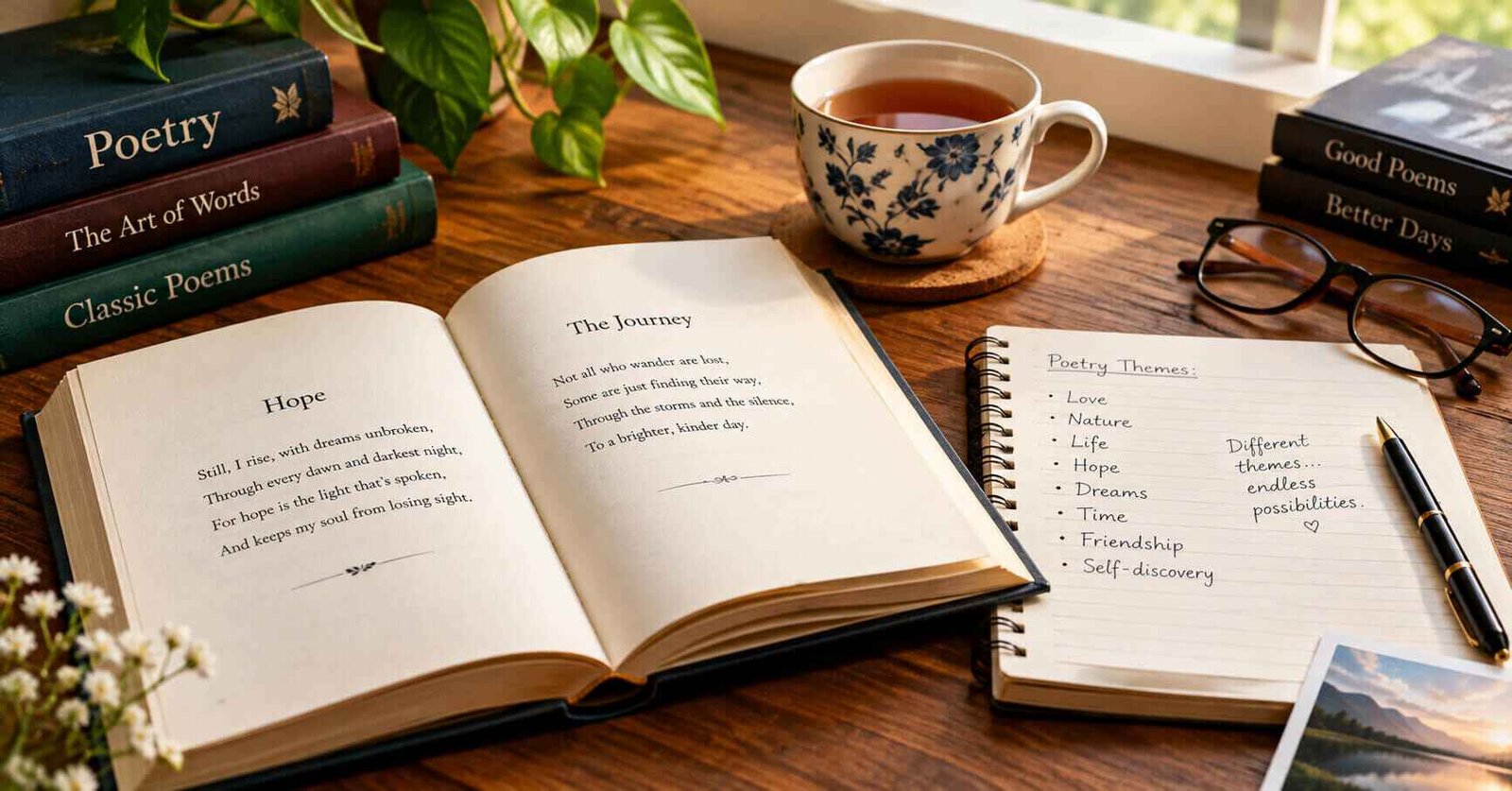
Poetry themes are the heartbeat of every poem: the big ideas hiding beneath images and rhythm. This guide is for students, poetry lovers and writers who want to recognise themes quickly, see famous examples and pick the right lines for essays, captions and cards.
Poetry themes are the big ideas poems explore, such as love, death, nature, time, identity, freedom and hope. They give a poem meaning beyond its words. Students, readers and writers use themes to understand a poem, write about it and choose the right verse for any moment.
Key Takeaway: A theme is not the topic of a poem but what the poem says about that topic, and learning to spot it makes every poem easier to read and enjoy.
Table of Contents
- What Are Poetry Themes?
- What Is the Difference Between a Theme and a Subject in Poetry?
- Poetry Themes About Love and Relationships
- Poetry Themes About Life, Time and Death
- Poetry Themes About Nature and Beauty
- Poetry Themes About Identity, Freedom and Society
- Poetry Themes About Hope and Faith
- Original Poetry-Inspired Lines by Thoughts in English
- When to Use These Poetry Themes
- How Do You Find the Theme of a Poem?
- Which Poetry Theme Fits Which Purpose?
- Tips for Working With Poetry Themes
- Common Mistakes to Avoid
- Frequently Asked Questions
- Conclusion
What Are Poetry Themes?
Poetry themes are the central ideas or big questions a poem explores, such as love, death, nature or identity, expressed through imagery, sound and emotion rather than direct argument.
A poetry theme is the deeper meaning behind a poem. It answers the question, “What is this poem really about?”
Poems are compressed language. A few lines must carry a whole feeling, so poets rely on images, comparisons and rhythm instead of long explanations. The theme is what a reader finishes with: a sense that the poem was really about loss, courage or wonder, even if those words never appear.
The tradition is celebrated widely. According to the Academy of American Poets, National Poetry Month was launched in April 1996 and is now observed every April. Each year, readers use it to rediscover how old themes keep finding new voices.
What Is the Difference Between a Theme and a Subject in Poetry?
The subject is what a poem is about on the surface. The theme is the deeper idea the poem suggests about that subject.
A simple formula helps: subject + what the poem says about it = theme. Robert Frost’s “The Road Not Taken” has a surface subject of two paths in a wood. Its theme is choice, and how people remember their choices later.
Emily Dickinson’s “Hope is the thing with feathers” has a bird as its subject. The theme is hope: quiet, persistent and asking for nothing. Tone and mood describe how a poem feels, while theme explains what it means.

Poetry Themes About Love and Relationships
Love is the oldest subject in poetry, but it rarely stays simple. Poets use it to explore devotion, longing, distance and the way another person can change how the world looks.
Love
- “Shall I compare thee to a summer’s day?” — William Shakespeare, Sonnet 18. The poem turns a familiar comparison into a promise that love can outlast the season.
- “How do I love thee? Let me count the ways.” — Elizabeth Barrett Browning, Sonnets from the Portuguese, 1850. It treats love as something both measurable and endless.
Loss and Grief
- “’Tis better to have loved and lost” — Alfred, Lord Tennyson, In Memoriam, 1850. The line comforts and aches at once, which is why it is quoted at funerals and farewells.
- “No man is an island.” — John Donne, Devotions upon Emergent Occasions. It is prose rather than verse, yet it remains one of the strongest statements about connection and shared sorrow.
Poetry Themes About Life, Time and Death
These themes ask how we should live when time is short. They are favourites in school anthologies because they connect so easily to real life.
Time and Change
- “Gather ye rose-buds while ye may.” — Robert Herrick, 1648. This is the classic carpe diem line, urging readers to enjoy life before it fades.
- “Look on my Works, ye Mighty, and despair!” — Percy Bysshe Shelley, “Ozymandias.” A ruined statue in a desert shows how even great empires disappear.
Death and Mortality
- “Because I could not stop for Death” — Emily Dickinson. Death arrives as a polite carriage driver, which makes the poem calm rather than frightening.
- “Death, be not proud.” — John Donne, Holy Sonnet X. Donne speaks to death directly and argues that it has less power than it claims.
- “Do not go gentle into that good night.” — Dylan Thomas, 1951. Written for his dying father, the poem urges resistance rather than surrender.
Memory and Nostalgia
- “They flash upon that inward eye.” — William Wordsworth, “I Wandered Lonely as a Cloud.” Wordsworth describes how a walk among daffodils returns to him as a private joy long afterwards.
In our experience curating poetry and quote pages at Thoughts in English, readers connect fastest when they first name the feeling a poem leaves behind, and only then label the theme.
Poetry Themes About Nature and Beauty
Nature poems are rarely just about trees or rivers. The natural world gives poets a mirror for human feeling, a place for wonder and a way to talk about big ideas through small things.
Nature
- “To see a World in a Grain of Sand.” — William Blake, “Auguries of Innocence.” Blake suggests that attention can make the smallest thing feel infinite.
- “Two roads diverged in a wood.” — Robert Frost, 1916. The forest becomes a stage for a decision, so nature and choice share the poem.
Beauty
- “A thing of beauty is a joy for ever.” — John Keats, Endymion, 1818. Keats argues that beauty keeps giving, even when the moment has gone.
- “Beauty is truth, truth beauty.” — John Keats, “Ode on a Grecian Urn.” The line has been debated for two centuries, which proves how rich a short statement can be..
Poetry Themes About Identity, Freedom and Society
These themes look outward as well as inward. They ask who we are, who gets to be free and what happens when a community faces conflict.
Identity
- “I celebrate myself, and sing myself.” — Walt Whitman, “Song of Myself.” The opening line is a bold declaration of selfhood.
- “I’m Nobody! Who are you?” — Emily Dickinson. She playfully turns privacy into a kind of freedom.
- “I, too, sing America.” — Langston Hughes, 1926. A short, firm claim of belonging.
Freedom
- “I know why the caged bird sings!” — Paul Laurence Dunbar, “Sympathy,” 1899. The caged bird became a lasting symbol of longing for freedom, later echoed in Maya Angelou’s memoir title.
- “Yearning to breathe free.” — Emma Lazarus, “The New Colossus,” 1883. These words, linked to the Statue of Liberty, connect freedom with hope for a new life.
War and Conflict
- “The old Lie.” — Wilfred Owen, “Dulce et Decorum Est.” Owen uses these words to challenge the idea that dying for one’s country is glorious. According to the Imperial War Museums, he was killed in action in November 1918, only days before the war ended.
- “In Flanders fields the poppies blow.” — John McCrae, 1915. The poppy later became a symbol of remembrance.
Poetry Themes About Hope and Faith
Hope and faith give poems a forward motion. They do not deny pain, yet they insist that something good is still possible.
Hope
- “Hope is the thing with feathers.” — Emily Dickinson. Hope is small, light and always singing, even in a storm.
- “To strive, to seek, to find, and not to yield.” — Alfred, Lord Tennyson, “Ulysses.” An older hero refuses to stop exploring.
- “If Winter comes, can Spring be far behind?” — Percy Bysshe Shelley, “Ode to the West Wind.” A question that doubles as a promise.
Faith and Spirituality
- “Glory be to God for dappled things.” — Gerard Manley Hopkins, “Pied Beauty.” Hopkins finds the sacred in freckled skies and spotted cows.
- “Death, be not proud” also belongs here, because Donne’s argument rests on faith in eternal life.
Original Poetry-Inspired Lines by Thoughts in English
These short lines are written for writers, students and creators who want a fresh voice beside the classics. Each is original to thoughtsinenglish.org.
- Love: “You are the quiet room my heart comes home to.”
- Grief: “Absence is just love with nowhere to land.”
- Time: “The clock never argues; it only leaves.”
- Death: “Even the last page is part of the book.”
- Memory: “Some afternoons live inside us rent-free.”
- Nature: “The river keeps no secrets, only directions.”
- Beauty: “Look twice; the ordinary is shy.”
- Identity: “I am the sum of every name I learned to answer to.”
- Freedom: “Open windows are the beginning of every poem.”
- War: “Peace is the poem the world keeps forgetting to finish.”
- Hope: “Morning does not ask permission.”
- Faith: “I pray in whispers, and the world answers in light.”

When to Use These Poetry Themes
Knowing the theme helps you choose the right poem at the right moment. These are the situations where it matters most:
- Writing a school or college essay on a poem
- Preparing for an exam question on theme, tone or imagery
- Choosing a verse for a wedding, funeral, graduation or farewell card
- Finding a caption or bio line for social media
- Picking a poem to read aloud in class or at an open mic
- Planning your own poem and deciding what it should say
- Building a themed reading list for a book club or classroom unit
How Do You Find the Theme of a Poem?
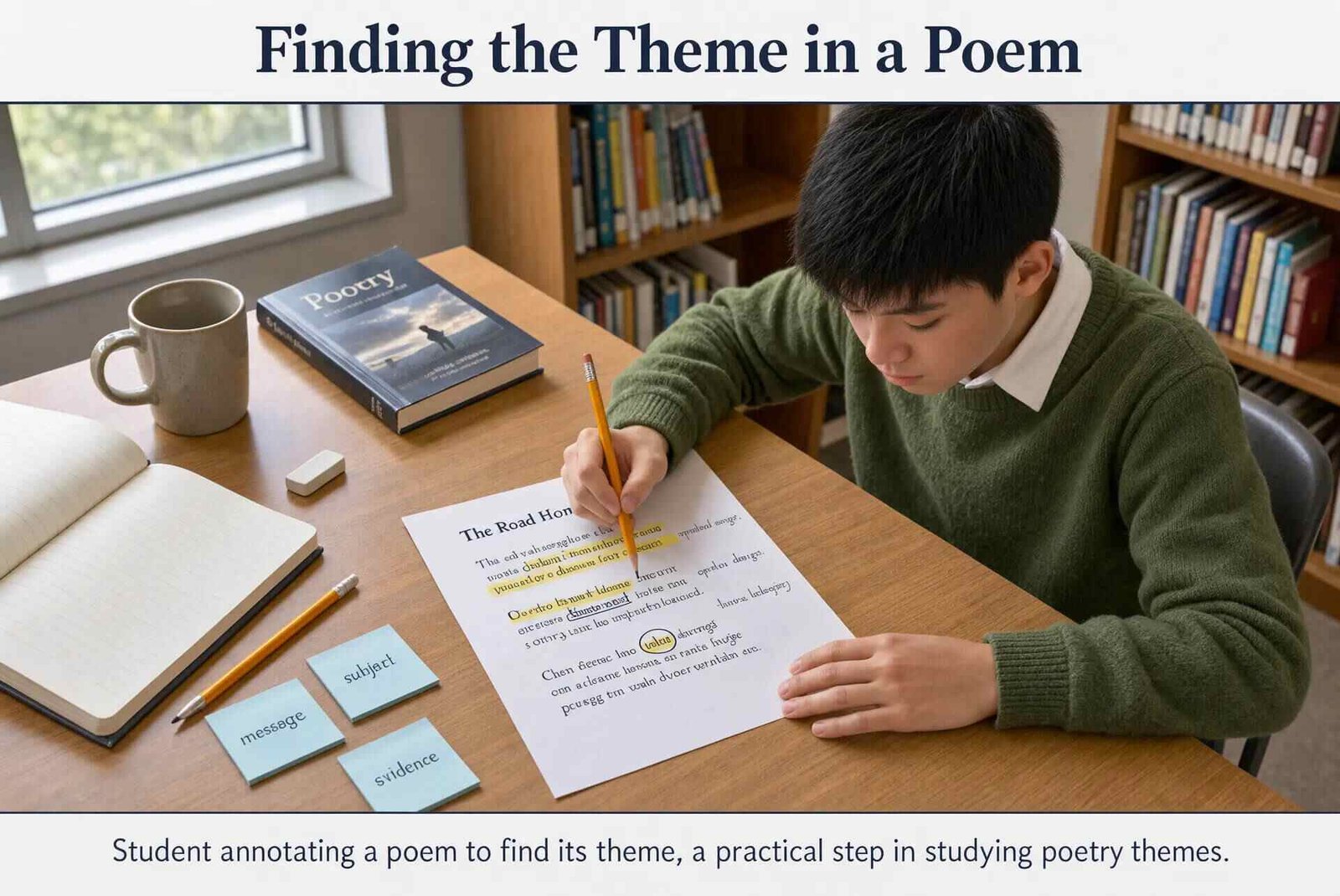
Read slowly, note the images and feelings, ask what the poem says about its subject, and state that idea in one sentence.
- Read it twice. Once for the sound, once for the meaning.
- Write the subject. Say in a few words what the poem is about on the surface.
- Underline images. Note repeated objects, colours, weather or places.
- Notice the turn. Many poems change direction near the end. That shift often reveals the idea.
- Name the feeling. Ask what you feel when you finish, and why.
- Write one theme sentence. For example, “The poem suggests that hope survives in small, quiet ways.”
- Test it with the text. Choose two lines that support your sentence. If you cannot find any, revise.
Which Poetry Theme Fits Which Purpose?
Love and grief suit cards, time and death suit reflection, nature and beauty suit captions, identity and freedom suit essays, and hope suits motivation. Use the table below to match theme to purpose.
| Theme | Famous example | Mood | Best for |
|---|---|---|---|
| Love | Sonnet 18 | Warm, tender | Wedding and anniversary cards |
| Loss and grief | In Memoriam | Sad, gentle | Sympathy messages |
| Time and change | “Ozymandias” | Thoughtful, serious | Essays, speeches |
| Death | “Death, be not proud” | Bold, solemn | Literature classes |
| Nature and beauty | “Auguries of Innocence” | Calm, wondering | Captions, nature posts |
| Identity | “Song of Myself” | Confident | Bios, self-expression |
| Freedom | “Sympathy” (Dunbar) | Longing, strong | History and civics work |
| War | “Dulce et Decorum Est” | Angry, sorrowful | Remembrance events |
| Hope | “Hope is the thing with feathers” | Uplifting | Motivation, graduation |
Tips for Working With Poetry Themes
- Start with feeling, not labels. Your first reaction is useful evidence.
- Write the theme as a full sentence. “Love” is a topic; “Love can outlast time” is a theme.
- Quote small. Two or three lines are enough to prove a point.
- Look for contrasts. Light and dark, near and far, then and now often carry the theme.
- Read the poem aloud. Rhythm can reveal emphasis you missed on the page.
- Compare poems. Reading two poems on one theme shows how differently poets handle it.
Common Mistakes to Avoid
- Confusing subject with theme. A poem about a bird is not automatically a theme of birds.
- Using one word only. “Nature” is vague. Say what the poem suggests about nature.
- Ignoring tone. An angry poem about love is not the same as a joyful one.
- Forcing a theme. If the text does not support your reading, change your reading.
- Quoting too much. Modern poems may be protected by copyright, so use short, credited lines.
Frequently Asked Questions
What are the most common poetry themes?
The most common poetry themes are love, death, nature, time, identity, freedom, hope and loss. Poets return to them because they are universal human experiences. Each age gives them new language, yet the questions stay the same: how to love, how to endure, and how to understand a short, fragile life.
What is the difference between a theme and a subject in poetry?
The subject is what a poem is about on the surface, such as a rose or a road. The theme is the deeper idea it suggests, such as love or choice. A poem about a rose may have a theme of fleeting beauty. Always ask what the poem says about its subject.
Can a poem have more than one theme?
Yes. Most good poems carry a main theme and one or two supporting themes. Dickinson’s “Because I could not stop for Death” is about mortality, yet it also touches on time and eternity. When you write about a poem, name the strongest theme first, then show how the others support it.
How many poetry themes are there?
There is no fixed number. Most lists group poems into a handful of broad categories, but themes overlap and combine in endless ways. A poem about a lost home can hold memory, grief and identity at once. Treat any list, including this one, as a map to explore rather than a rulebook to memorise.
What is a good poetry theme for a school assignment?
Choose a theme you can feel and explain, such as hope, nature, identity or loss. Then pick a poem with clear imagery, like Frost’s “The Road Not Taken” or Dickinson’s “Hope is the thing with feathers.” Quote two or three lines, explain what they suggest, and connect them back to the theme.
Conclusion
Poetry themes are the bridge between a poem and a reader. Once you can name them, every poem opens up: love becomes more than a word, nature becomes more than scenery, and a few lines can hold a whole life. Start with feeling, test your idea against the text, and trust your own voice.
Best for: students, teachers, poets and creators who want to understand poems, write about them and choose meaningful verses for essays, cards and captions.
If this guide helped, keep exploring more poetry and quote collections on [Thoughts in English.].